

WGS 2026 Dubai: Most Reformed Government Global Award goes to Paraguay President
Award highlights innovation, efficiency, and citizen-centric governance practices
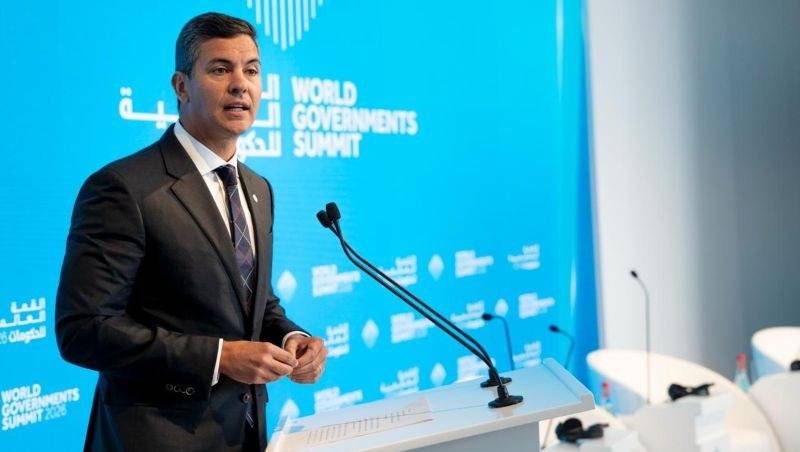
DUBAI – UAE President His Highness Sheikh Mohamed bin Zayed Al Nahyan today presented the Most Reformed Government Global Award to Santiago Peña Palacios, President of the Republic of Paraguay, during the World Governments Summit 2026 in Dubai.
The event, which drew high-level participation from leaders, ministers, and senior officials from around the world, highlighted exemplary government reforms and innovations that drive progress in nations globally.
His Highness Sheikh Mohamed bin Zayed Al Nahyan emphasised that enhancing government capabilities remains a priority for nations navigating rapid global transformations. He stated that operational frameworks grounded in efficiency, excellence, innovation, and proactivity are essential for governments to anticipate change and deliver meaningful impact to their citizens.
“The World Governments Summit reflects the UAE’s vision to provide an open platform for dialogue, partnerships, and knowledge exchange,” he added. “It celebrates the world’s most outstanding government experiences and innovative models that have transformed communities and shaped the future.”
¡El mundo reconoce al Paraguay Gigante! ????????
— Presidencia Paraguay (@PresidenciaPy) February 4, 2026
El Presidente de la República, Santiago Peña, recibió el Premio Global a las Reformas Gubernamentales, un galardón que distingue a nuestra nación por encima de otros 10 países competidores. pic.twitter.com/duFwIivSzL
Congratulating Paraguay, His Highness Sheikh Mohamed highlighted the country’s commitment to transparency, good governance, and innovation. “I wish Paraguay and all nations continued success in serving their societies and driving prosperity,” he said.
The award ceremony was attended by Sheikha Latifa bint Mohammed bin Rashid Al Maktoum, Chairperson of Dubai Culture and Arts Authority, alongside a host of Sheikhs, ministers, senior officials, and international representatives.
The Most Reformed Government Global Award
The Most Reformed Government Global Award recognises countries that set global benchmarks in governance, transparency, sustainable development, and digital transformation. Candidates are evaluated against rigorous international indicators measuring national excellence in reform and innovation pathways.
Assessment for the award is conducted in collaboration with knowledge partner Ernst & Young, considering factors such as economic progress, governance strength, institutional effectiveness, and development-oriented policymaking. Reforms are examined for their effectiveness, innovation, impact, and sustainability. Key evaluation pillars include transparency, accountability, alignment with national priorities, and contributions to the Sustainable Development Goals.
Focus on digital transformation
A core aspect of the award is digital transformation. The evaluation examines originality and transformative effects of government reforms on processes and service delivery. This includes novel approaches, technology utilisation, and structural, procedural, or cultural shifts in governance practices.
Forward-looking, innovative, and experimental solutions are highly valued, reflecting the summit’s emphasis on future-ready government systems.
Governance strength
The governance pillar measures implementation effectiveness, clarity of frameworks, and stakeholder coordination. It considers leadership commitment, institutional capacity building, and mechanisms for collaboration between government entities and with other sectors. Change management, responsibility definition, and accountability structures are critical components in assessing governance performance.
Citizen-centric innovation
The award also highlights citizen participation and inclusiveness. It measures the integration of citizen feedback, partnerships with private sector and academia, and transparency mechanisms. Outcomes such as improved service efficiency, accessibility, cost rationalisation, and citizen satisfaction are key indicators. Reforms demonstrating long-term systemic impact on national development are prioritised.
Sustainability and replicability
Sustainability forms another pillar of evaluation, examining the institutionalisation of policies, financial and operational longevity, and potential for replication at regional, national, or global levels. Initiatives that embed reform into organisational structures and create lasting value are considered exemplary.
World Governments Summit
The World Governments Summit serves as a global platform to showcase government innovation, recognising achievements in leadership, education, technology, and policy. Awards presented during the summit include the Best Minister, Best Teacher, leading technological solutions, edge-of-government innovations, and initiatives that enhance future-readiness and sustainability. Through this framework, the summit fosters dissemination of best practices, strengthens government knowledge, and highlights distinguished models of public service.
Paraguay’s recognition underscores its progress in advancing government work through efficiency, transparency, and forward-looking reforms. The country’s achievements in improving governance and citizen services position it as a benchmark for others seeking transformative reform.